
The Critically Damped Diplomat
Adam Blvck, 2026-03-02
To speak with people and to be diplomatic with people is often seen as a very hard problem. It's a hard problem because there is no singular solution to any particular confrontation, and the problem increases exponentially as more variables ought to be considered. In Computer Science, this is called an NP-problem.
Interestingly, we are currently living in probably one of the most conflictious, misunderstood, and perhaps the most passively-inflamed times that we have ever lived in.
This is mainly because the veils of enmities, pleasures, and superficial levels of coping are falling away — and we want to break through. We want to break through into bigger spheres of meaning, understanding, into living with a purpose. And then suddenly we see an agent — a human being or some other entity — somehow enact or exercise their free will in such a way that there is suddenly conflict again.
Even though a whole community or a country might have done its best to set up a system where everyone can prosper in their own agentic way, suddenly another country might decide that they feel oppressed by some ideology, some misunderstanding, some historical or cosmic trauma, or whatever might be the issue.
Suddenly there is a collective cultural momentum vector which perturbs many people to think and believe the same thing, and they are taken by this collective energy in such a powerful way that many things of life fall back into the background. Family groups fall apart. Communities splinter.
And generally speaking, there is this issue of: what are we actually doing here? Because of the conviction and the deep pain and trauma that is being held and experienced in the world, we always get put into this weird place where we are being forced to play the diplomacy game — or to indeed engage in bigger ways.
Person to person diplomacy. Network to network diplomacy. And then at the ultimate level, system to system diplomacy — which is an art of itself. Because there is a level of abstraction of the individual: especially from the moment that we enter into a group dynamic, the individual becomes part of the group. Suddenly a group energy is formed, a center of mass of the group emerges, and there is an abstraction of the individual agents.
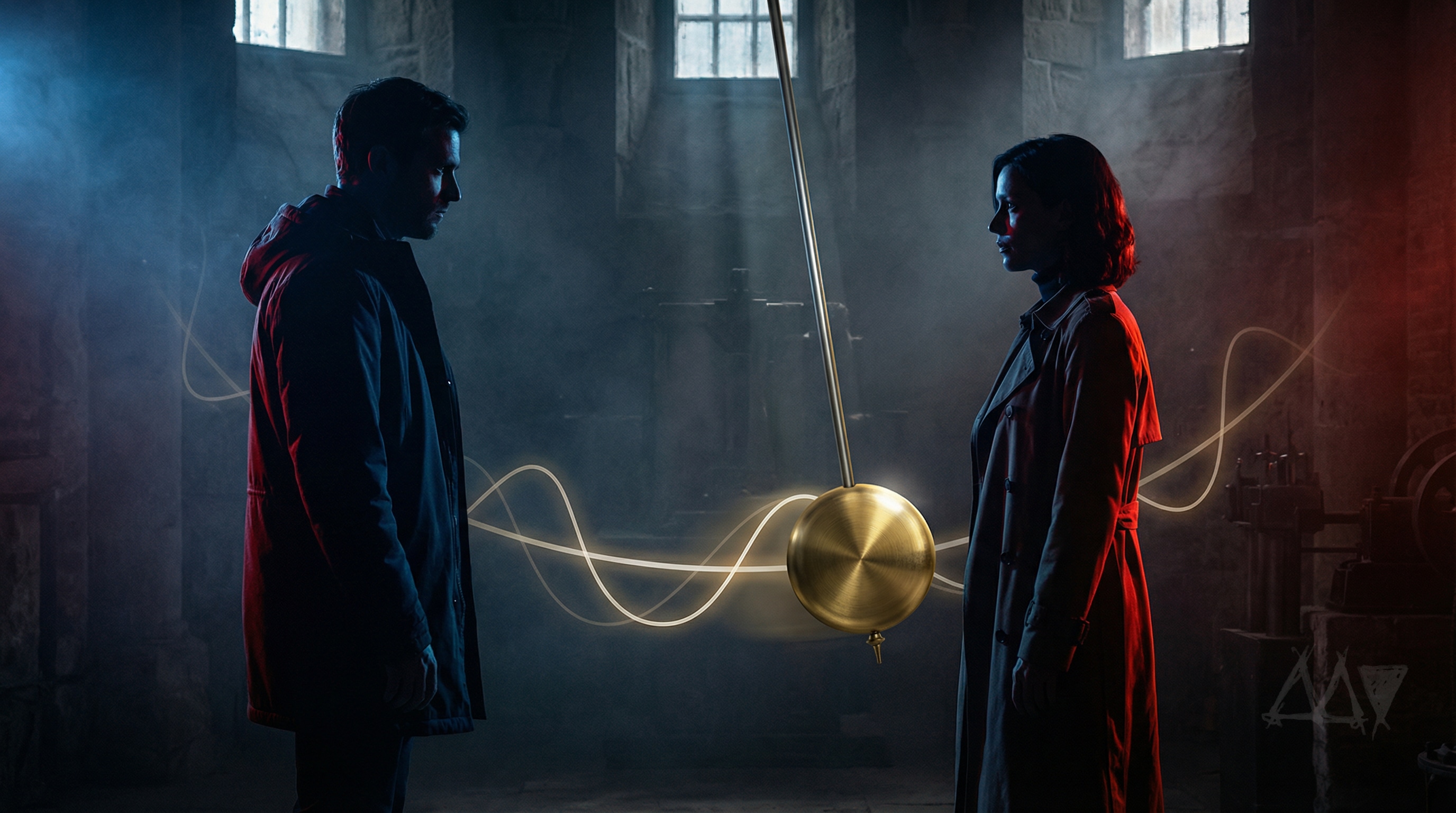 The pendulum of conflict — swinging endlessly between two opposing perspectives
In this post, then, I want to write about a physical phenomenon that might help us understand and establish how one can obtain a balanced diplomatic point of view — without getting into the swinging between two extremes that is almost always present when there is conflict and we engage with it with passion and fire to try to resolve it.
Conflict and the Instinct to Push Back
Before I enter into the physics, I want to state that many conflicts, when we try to resolve them through a form of weapon or violence or a strong pushback, this causes more disturbance in the system. Further, it usually causes a form of ignition of the conflict such that it spreads further than it was before. We see this currently with the wars that are being engaged across the globe. And we see this in all types of conflict that are being waged across Europe, America, the Middle East, and everywhere, essentially.
Now, I'm not going to speak about politics and policy and how problems should be resolved at a geopolitical level. That's a huge, powerful manifestation that follows after us being able to speak with each other and resolve conflicts at a local level.
So let us then consider the pendulum.
The Harmonic Oscillator
In physics, one of the most important objects of study is the pendulum — or rather, the harmonic oscillator, which is essentially a mass on a spring or a ball on a piece of string. It oscillates back and forth. In the ideal situation, once you start to swing it or once you stretch the ball on the spring, it will keep on oscillating up and down, up and down, or left and right on the swing.
The movement described by the spring is an interesting calculation in itself. But the main solution is that it follows a sine wave. The ball follows a sine wave — and perhaps a cosine wave in the left-to-right direction. The cycle of movement of the harmonic oscillator is actually described by coordinates on a circle — a stretched or perhaps perfect round circle.
The equation for the simple harmonic oscillator is:
$x(t) = A \cos(\omega t + \varphi)$
where $A$ is the amplitude, $\omega$ is the angular frequency, and $\varphi$ is the phase offset. This describes the position of the oscillator as a function of time, tracing out a perfect sinusoidal path — and when viewed in phase space ($x$ vs $\dot{x}$), it traces a perfect circle.
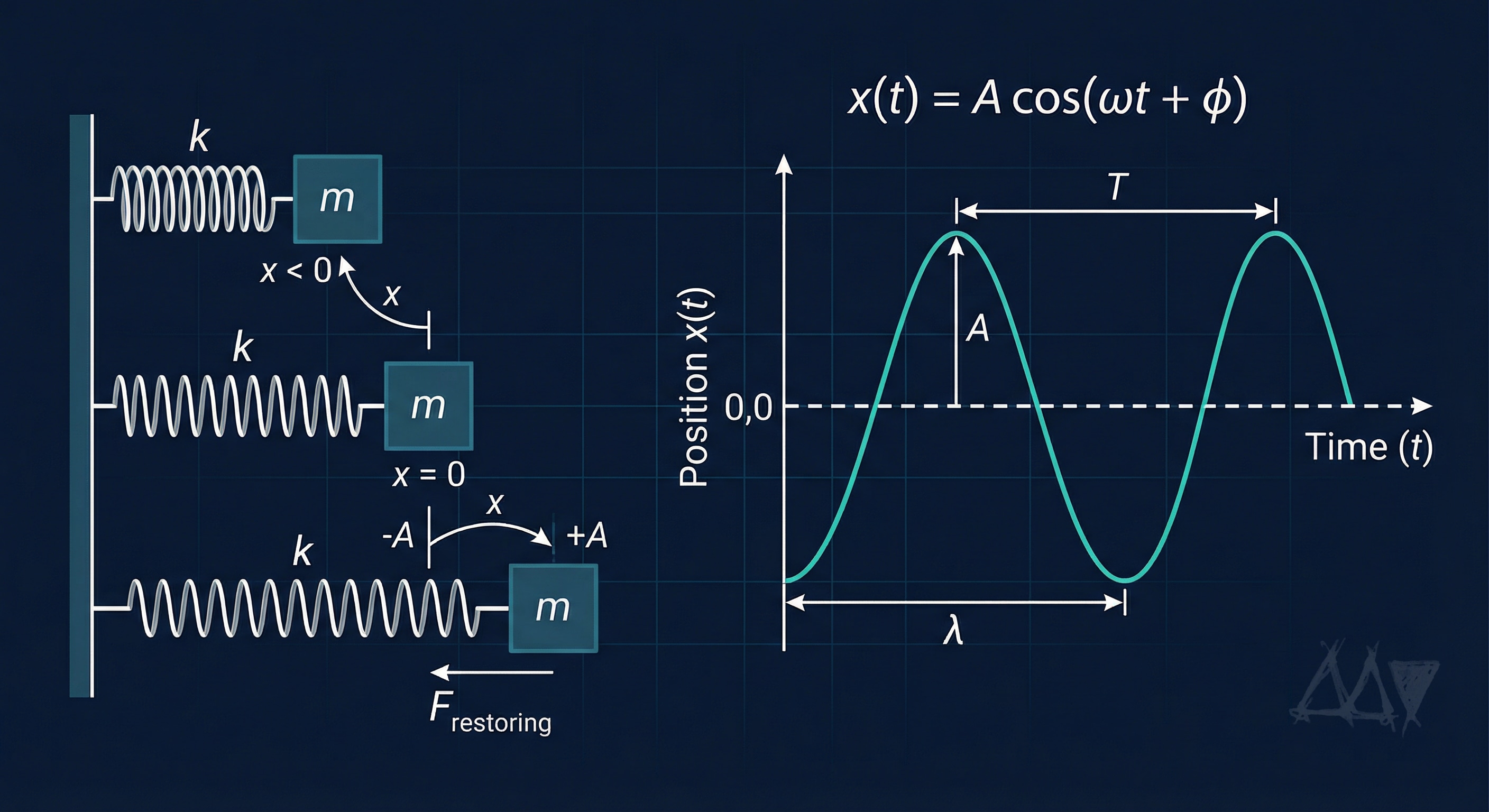 The simple harmonic oscillator — mass-spring system and its sinusoidal solution
And obviously, almost any system in physics is eventually described by a harmonic oscillator — because almost everything in physics is eventually a wave. Especially once we get into collective movement of many atoms or many water molecules in a fluid, wave mechanics and the cyclical nature of harmonic oscillators become very important. And even much so in the study of light, elementary particles, and quantum mechanics.
The Non-Ideal Pendulum: Driven and Damped
However, in this post, I now want to enter deeper into the non-ideal pendulum — a pendulum that has some stiffness built into the spring, which causes it to either be driven or damped.
The driven oscillator: imagine a pendulum that is oscillating, and you keep on pushing it — always with the direction of movement, essentially adding energy to the system. The oscillations get worse and worse and worse. Bigger and bigger. More and more violent.
The damped oscillator: on the other hand, you could have a pendulum where the part attached to the mass and the pivot point has some resistance — meaning that the oscillatory movement is damped.
So in physics, once you have studied the ideal oscillator, the next step is to study the damped oscillator or the driven oscillator. The general equation of motion for the damped harmonic oscillator is:
$m\ddot{x} + b\dot{x} + kx = 0$
where $m$ is the mass, $b$ is the damping coefficient, $k$ is the spring constant, $\dot{x}$ is velocity, and $\ddot{x}$ is acceleration.
You can see that in conflict resolution — if you bring it back — what we're trying to do is balance out the swinging. There is an oscillation between polarities. An oscillation between powers. An oscillation between who pays what and how. There is this oscillatory movement between conflict and peace, between fairness and unfairness.
And then this fairness perception is obviously dependent on your perspective. Depending on which side you start to label your position, the opposite direction is the one you are labeling as undesirable. Whereas when you are on the other side, you see that it actually improves your situation.
Even when we look at the most basic depiction of politics, you can be on the left or on the right. And somehow these two never agree — because even though the values themselves might be the same over time, the same value might shift perspective on the left or on the right. There is something very interesting to unpack there.
The Three Solutions of the Damped Oscillator
But in the case of our example here, if you focus on the damped oscillator, there is a very interesting thing that emerges out of physics which I think applies directly to how we resolve conflict.
The damped oscillator — a pendulum swing or a mass on a spring that oscillates and is damped. Mathematically speaking, there are only three possible classes of solutions that describe the movements of the damped oscillator.
The Overdamped Solution
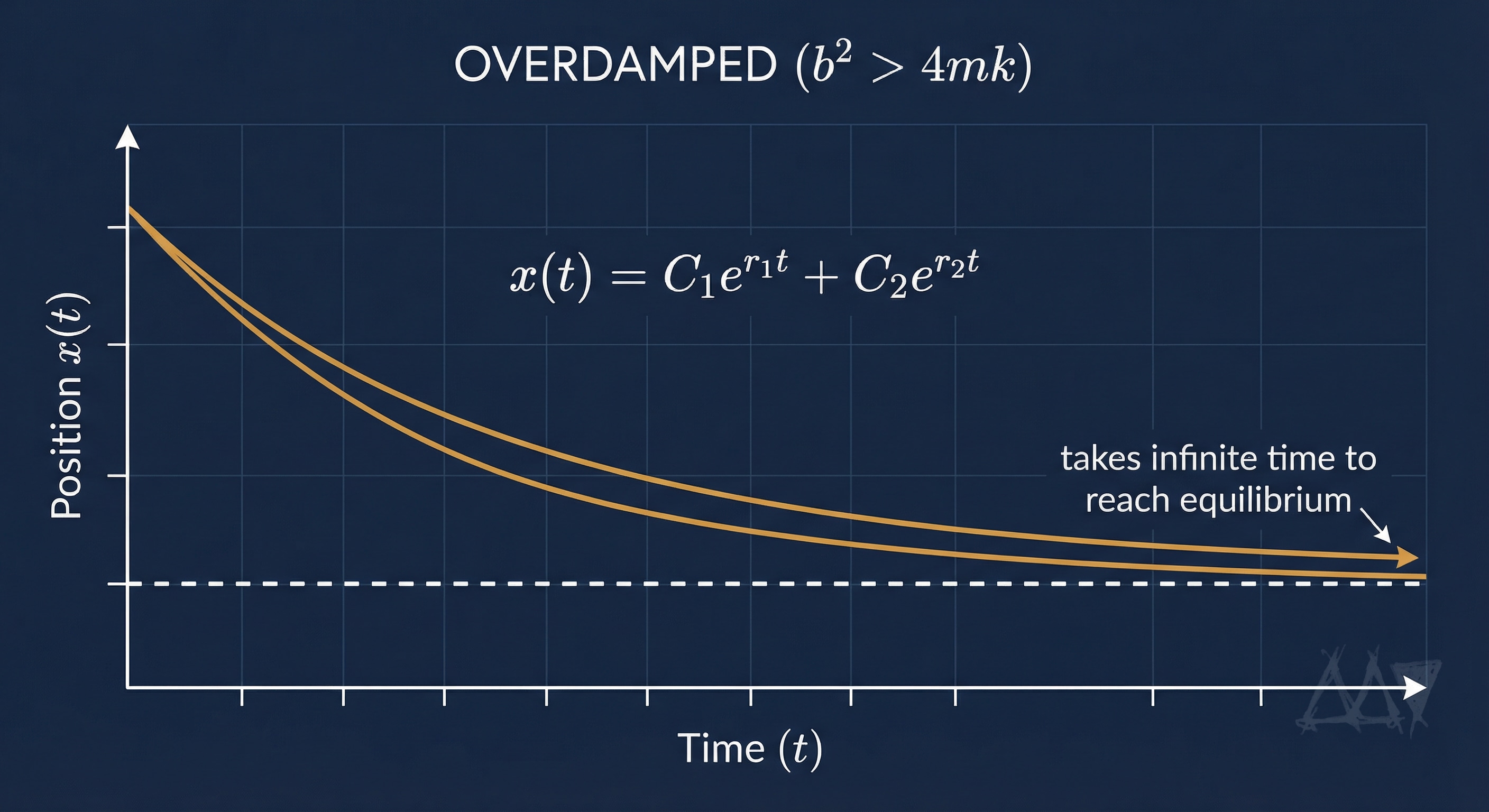 The overdamped response — gently approaching equilibrium, taking infinite time
The damping on the oscillator is so strong that it stops being an oscillator. It gently, slowly moves toward equilibrium — but it takes an infinite amount of time to get into balance. So obviously in the real world there is friction, and the damping always reaches equilibrium in finite time. But let us imagine a frictionless, superconducting world where everything smoothly flows — and there is damping. Then it takes an infinite amount of time to reach stability on average.
That's the first solution.
The Underdamped Solution
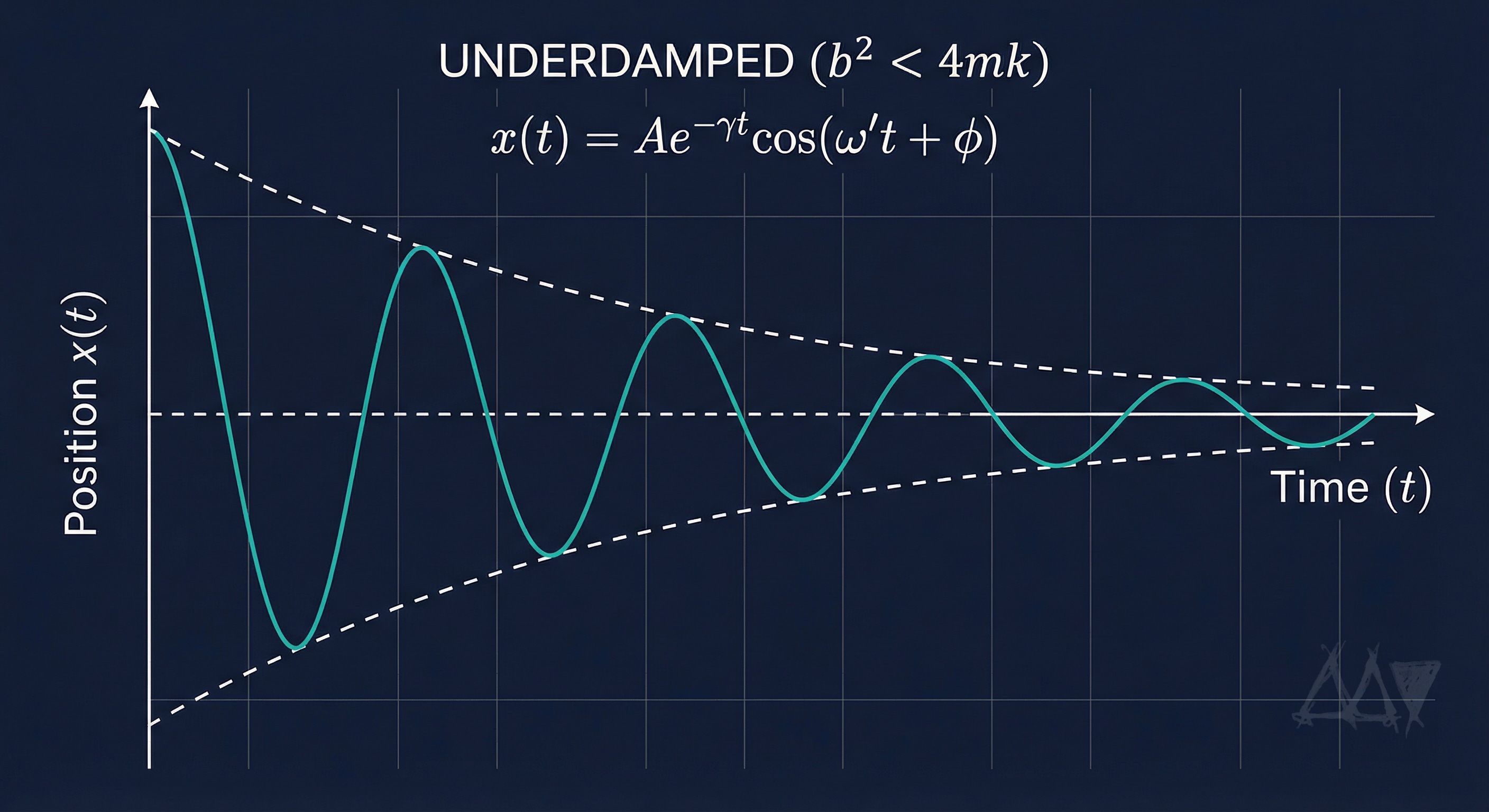 The underdamped response — oscillations persist with decreasing amplitude
The second solution is an oscillator that keeps oscillating but gets weaker and weaker and weaker. It takes again an infinite amount of time before it reaches equilibrium. It keeps oscillating, but at a lower amplitude — less and less and less strength — because it's underdamped. It keeps oscillating, keeps oscillating, keeps oscillating until the end of time, where the last molecule oscillates into equilibrium. But that's at infinite time. Again, we are working with idealized approximations without friction.
That's the second solution, mathematically speaking.
The Critically Damped Solution
And then we have the third solution: the critically damped solution. The critically damped oscillator moves into equilibrium in the most efficient way possible. It reaches equilibrium at exactly one swing to the other side — and then it perfectly settles into the balanced state. Critically damped.
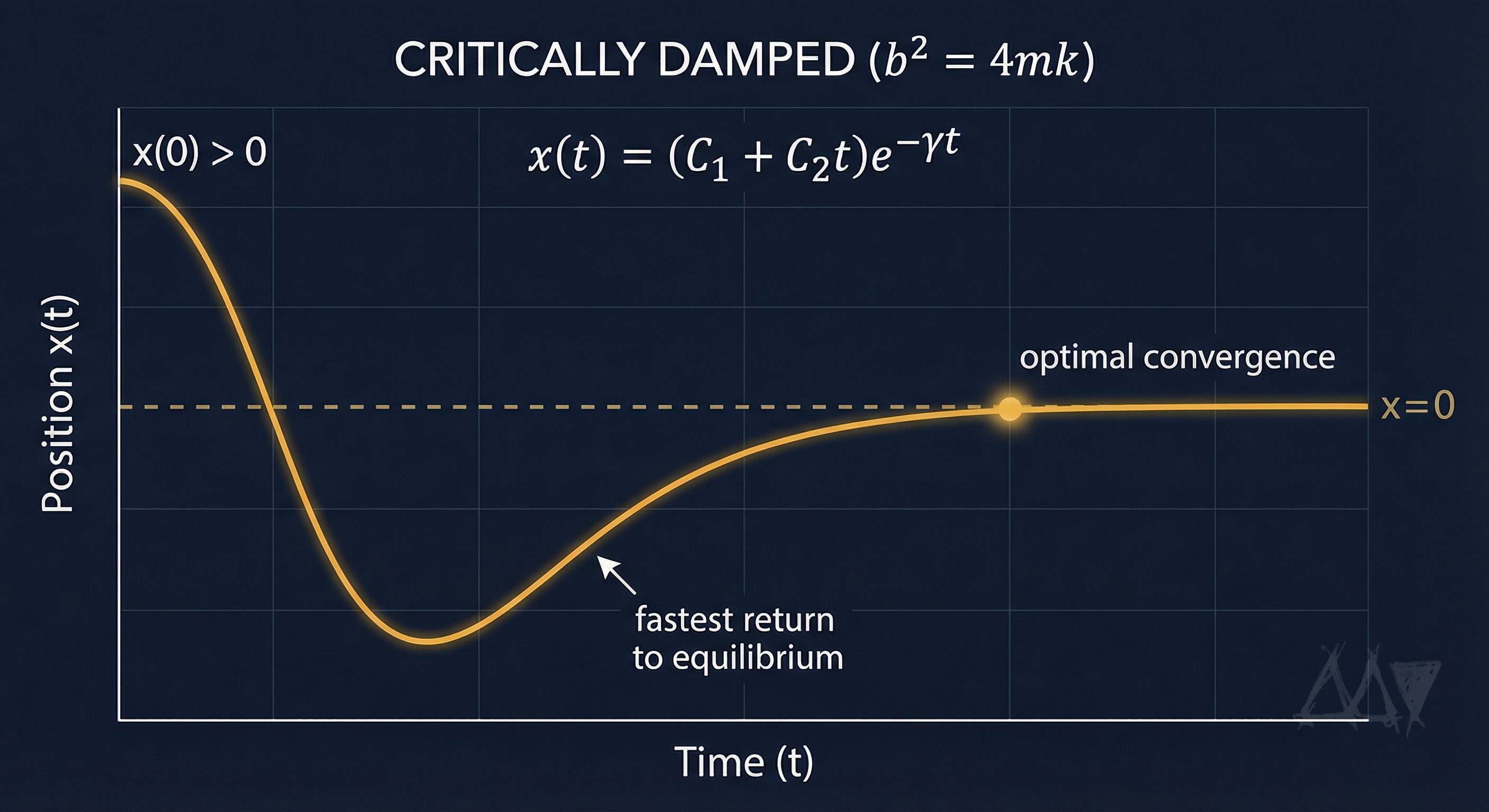 The critically damped response — the fastest possible return to equilibrium
On your car dashboard, when you have your analog dials indicating how fast you're driving — those hands are perfectly critically damped. Imagine if you accelerated to 30 miles per hour and suddenly the hand oscillated back and forth around 30 all the time — that would be underdamped. If that hand would slowly and gently start to approach 30 miles per hour, taking forever to get there — that would be overdamped. Whereas in the critically damped indicator, the hand overshoots 30 only once, and then it lands perfectly at 30 miles per hour.
This is especially true for analog indicators, because currently all of our dashboards are digitally driven and there is more sophistication built in. But any control system that wants to control a system in the most optimal and quickest way needs to have a critical parameter set — which ensures that any imbalance is only reached once, and then you are in your control position of balance where you want to be.
These are the three solutions.
Applying Critical Damping to Conflict Resolution
Now, when we take this into conflict resolution — into how we should be speaking with each other — one of the biggest problems that I personally encounter when speaking with human beings is that the tone I use isn't appropriate. Or you have two people who keep talking louder and louder, and there is suddenly pretense and regulatory tones. And maybe they start shouting at each other because suddenly their conflict goes into a driven oscillator — where they are driving their oscillatory positions further and further apart.
Critically damped conflict resolution matches the energy of the opposing party exactly — without adding anything to it or removing anything from it. It matches it exactly in tone, in directness, and perhaps even in expression and exactness. Such that, in the ideal world, the perfect conflict resolution is delivering a message with force once. It's using a tone of voice to deliver that message once. And then seeing where the swing is balancing now — is it more imbalanced, or less?
I think that physics — this physical picture of the balanced swing and the critically damped oscillator — is really a powerful thing to keep in mind when we are trying to speak with other human beings. Obviously, we as human beings can never be perfect, because perfection only lives in mathematical or Platonic space. However, we can always try to approximate and live towards this ideal.
The Dance of Diplomacy
In a discussion that is heavy — about religion, about wars, about policy, about truth, about perspectives, about bigger conspiracies — what happens is that we often gain opportunities to enter into either a driving oscillatory force where you make the divide bigger between the swings of two people speaking, or you try to negotiate into a balance. But somehow you overdamp or underdamp your message, your diplomatic skills. And you keep talking forever. Or it's a very one-sided talk. But it's never a critical delivery.
The critical conflict resolution — the critical diplomacy — is one that ensures that the other party feels the weight of your message once. And they understand it. And they feel it. And then they give more of their own, probably. And usually — because we are always dealing with another human being that we cannot control — if one human being decides to deliver their message in a critically damped way, it's almost as if by law of physics the balance will be restored in the most optimal way, every time.
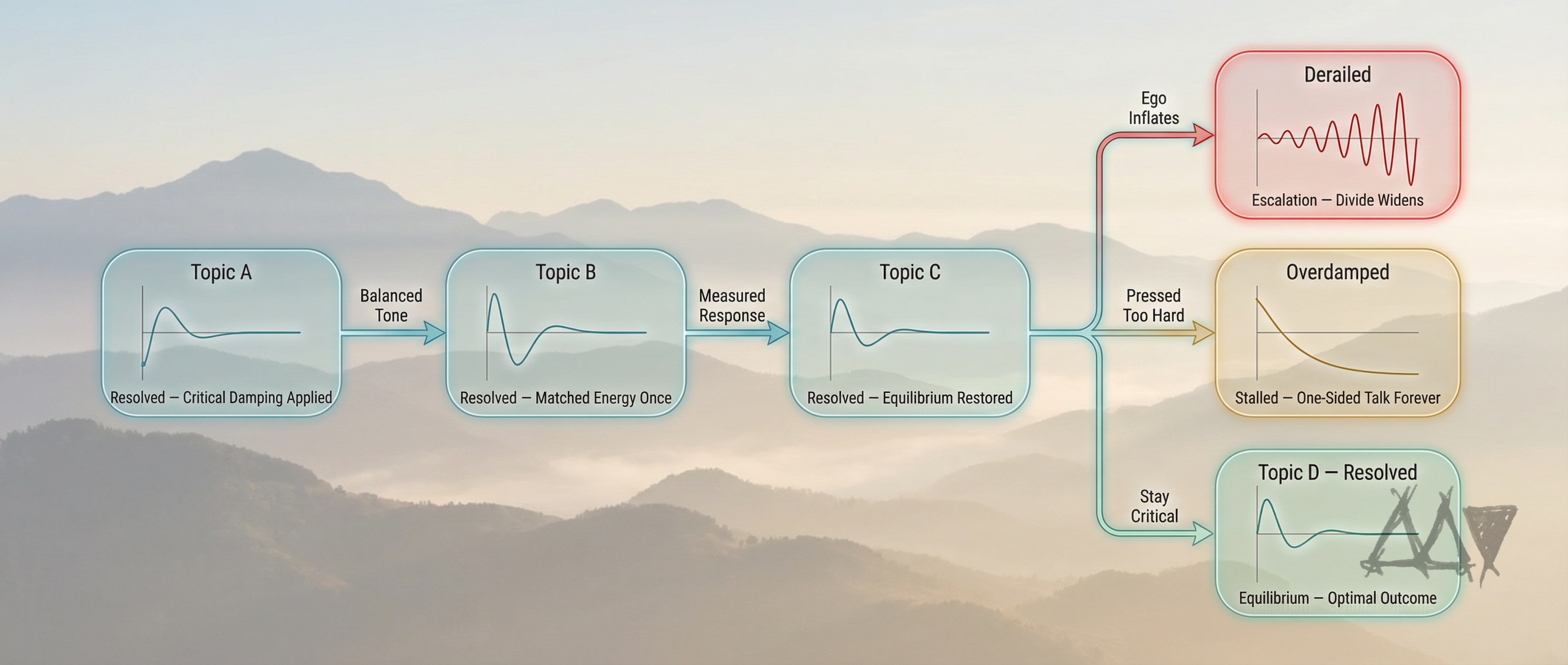 The flow of a critically damped diplomatic discussion — and the three divergence points where ego, force, or balance take over
But we have to be cautious. The ego can get in — and suddenly, after a few very good exchanges, the other person starts to feel that something is going wrong: "I'm losing ground. I'm getting too empathetic." And what happens is that the other might suddenly drive the oscillator, triggering you into a shadow behavior, into your negative expression. You get triggered, and then you are back into the driving force — not trying to damp the oscillator, but escalating it further.
And so there is this very interesting dance between how a discussion can unfold. When we are talking, we are holding a dance with another human being, or another party, or another group — where there is this oscillatory movement left and right between two parties.
Closing Thoughts
A diplomatic endeavor is a long-term series of decisions and skills that one can hold on to — to try to engage in perfectly and critically damped discussion holding. So that we try to always move towards a balanced situation, instead of escalating by driving it, or by trying to damp it in a suboptimal way.
I hope this gives you a physical framework to keep in mind next time you find yourself in the heat of a difficult conversation.
Much Much Love.
This post has been made from contemplating Gene Key 6