
When Surfaces Talk
Adam Blvck, 2026-02-09
Metaphysical claim: Humans are complex beings with infinite degrees of freedom, which is why being-to-being interactions are mostly surface-level.
Allow me to introduce a bit of beautiful and useful mathematics to build up the argument.
Take a volume. Any nice volume. Now we ask:
On average, where is stuff inside this volume?
It makes sense to ask this question with regards to the center of the volume. It turns out, there’s a neat little formula for the average radial position ⟨r⟩ of points inside a volume:
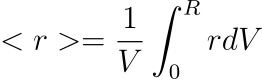
If math feels like an unwanted exorcism today, let me ease the process by clarifying the symbols:
- ⟨r⟩ = the average radius (distance from the center)
- V = the total volume (for a cube, (V = \text{width}^3))
- dV = a tiny “chunk” of volume (a volume element)
- R = the outer boundary radius of the volume
- The integral sums (r,dV) from the center (0) to the boundary (R), then divides by V, yielding the average radius of stuff in a uniform volume.
There's almost nothing exotic here: you take every point in the volume, measure how far it is from the center (radius r), then multiply by the little volume element dV, sum over all of it, and divide by the total volume V. If you actually do this integral for specific shapes, something curious happens.
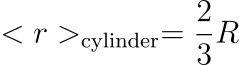
For a cylinder of radius R, the average radius comes out to:
For a sphere of radius R, you get:
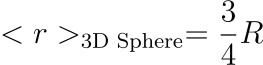
This is non-trivial, and I want you to savour this idea for a good minute.
In a cylinder filled with stuff, most stuff is found about 2/3 away from the center, not at the center of the cylinder.
Notice that for the sphere, the average radius is even closer to the edge (this is because 3/4 > 2/3).
Now I'm going one step further, which will allow me to make a compelling metaphysical argument that will shape your perspective on reality:
Consider an n-dimensional sphere (“hypersphere”) of radius R, you get the formula:
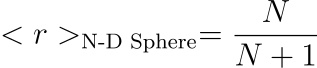
So as the dimension N increases, the average radius of particles moves closer and closer to the surface. In very high dimensions, almost all of the volume is effectively “living” in a thin shell near the boundary. You can see this beautifully on the following graph:
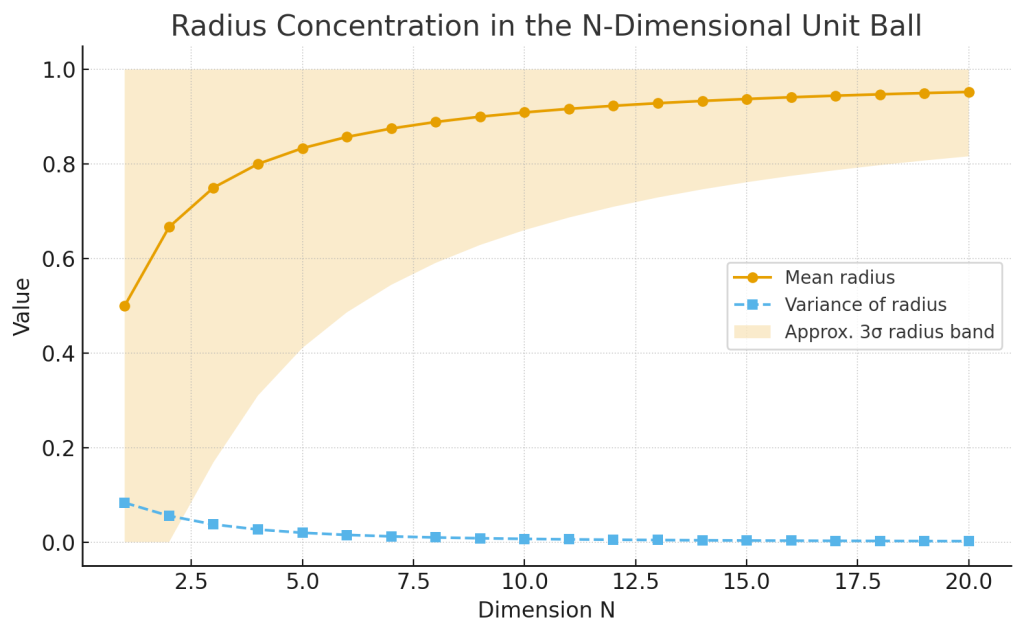
This is already a bit trippy: the higher the dimensionality, the more the bulk of the system becomes a surface phenomenon.
Hold that thought. Let us explore what this means physically, after which we’re going to bring it back to human beings.
From Hyperspheres to 10²³ Particles
Statistical physics describes how a glass of water with 100,000,000,000,000,000,000,000 molecules (Avogadro-scale: (\sim 10^{23})) responds to temperature, pressure, and other physical changes. One thing to keep in mind as you're reading this: we're dealing with an absolutely ridiculous number of particles, and yet we still label it as “this single glass of matter is at 30°C.”
To keep track of 10²³ particles directly is impossible, but somehow physicists still make precise predictions. How? After all, you are perfectly familiar with the idea of temperature and pressure without awareness of all these million-billion-billion particles.
Well look, each particle has a position, a momentum, maybe some internal degrees of freedom. Put that together for all particles, and you don’t just have three spatial dimensions anymore. You have this monster called configuration space, together forming a state with an absurd number of dimensions — one for every degree of freedom of every particle.
When we say, “the system is in some state,” what we really mean is that it is a single point in this gigantic, almost unthinkable high-dimensional space.
And then that little hypersphere result from before starts whispering: In high dimensions, most of the “volume” is happening / interacting / dancing / making itself known near the surface.
In other words, when we describe such systems statistically — pressure, temperature, entropy, free energy — we’re basically describing surface behavior in configuration space.
Modern science manages to say meaningful things about 10²³ particles, not by tracking every particle individually, but by understanding how the system behaves near high-dimensional “boundaries”: constraints, surfaces, interfaces.
A lot of thermodynamics is built on derivatives of state functions: how does energy change when you change volume, how does entropy change when you change temperature, and so on. These are, in a sense, “surface derivatives” in this high-dimensional state space. We’re tracking how things change at the boundary of what the system can do.
So: huge number of degrees of freedom, but effective description is often surface-based.
If you have this concept locked in—good. Now let’s walk over to humans.
Humans as High-Dimensional Objects
A human being has three spatial dimensions. That’s the easy part.
But if you look at a human as a system, the dimensionality explodes.
- Every joint angle is a dimension.
- Every muscle tension is a dimension.
- Metabolic variables, hormone levels, immune system activation states — more dimensions.
- Neural firing patterns and synaptic strengths — an insane forest of dimensions.
- Psychological states, memories, habits, social ties — more abstract, but still degrees of freedom.
- Embedding in society, culture, history, and even the evolutionary dynamics of the biosphere.
At some point, counting dimensions becomes pointless. You just gesture vaguely and say, “Yeah, it’s huge.”
Can you imagine a “configuration space of a human being” — not in any precise textbook sense, but as a conceptual tool? Every possible state of the human organism corresponds to a coordinate in this ultra high-dimensional space.
We remember the first three paragraphs of this article: in high dimensions, most of the stuff lives near the surface. Well, isn't that peculiar?!
So when two human beings interact, what is actually interacting with what?
Not the full interior of those state spaces. No sane model can handle that. No human being interacts with another human being in any normal conversation while being aware of the billions of cells undergoing Krebs-cycle dynamics when speaking with Jeff, nor are we aware of the insane kidney filtering mechanism when we talk to Sally.
When we interact with one other, we interact with signals that sit at the level of appearance:
- Skin
- Facial expressions
- Voice
- Gestures
- Words
- Social roles
- Shared symbols
All of these are surface phenomena. They’re like the thin shell where one mind-body system can “see” another mind-body system.
So you and I, or you and anyone else, are essentially surface-to-surface interfaces between enormous, almost ungraspable, high-dimensional volumes of potential states.
We talk to each other’s boundaries.
The Irreducible Human Being
I'm trying to verbalize a tension here:
On the one hand, in everyday life, we do reduce a human to truly superficial qualities.
- We say, “a person has this mass, this height.”
- In physics problems, we treat a human as a point mass.
- In social statistics, a human becomes a single data point in a population, or customer database.
Crazily enough, for some problems this works beautifully. You can predict how quickly someone falls under gravity without modeling their inner life, and you can group people together into common behaviours, which drives recommendation algorithms, from Google to YouTube.
But the moment you zoom in and actually care about the details — the limbs, the biomechanics, the metabolic state, the immune responses, the neural dynamics, the emotional landscape, the social context, the parental upbringing, the metaphysical assumptions, the traumatic lineage or past — the dimensionality explodes again. The “point” approximation breaks down.
At that level, the human becomes effectively irreducible. Every attempt to fully reduce the human to a finite list of variables is always missing… almost everything.
So we live in this paradox:
- We can treat humans as reducible data points (row in an Excel sheet) for certain calculations.
- But the real entity behind that point has what feels like near-infinite degrees of freedom.
This is part of why human behavior is so slippery. You can model patterns, predict tendencies, but the space of possible states is huge. There’s always some other direction in which a person can move — physically, mentally, socially, creatively.
But still, it's exactly because of this near infinite degrees of freedom that describe human beings, that most of our interactions are surface-level-to-surface-level, and that's why culture, ego, likes, followers, and how much money you have, effectively describes the infinite human being. It's math at this point.
Infinite Degrees of Freedom, Infinite Energy?
Now, if you take this idea seriously — that something has infinitely many degrees of freedom — you quickly run into an intuition: infinite degrees of freedom feels like infinite potential, and that smells like infinite energy. The craziest bit is that canonical Quantum Field Theory (as studied over 70+ years) also claims that the vacuum has infinite energy.
But here comes the catch: you can’t simply extract this infinite energy.
Think of the good old “pull yourself up by your bootstraps” paradox. You can’t lift yourself by pulling on the thing you’re standing on. You need an external leverage point—something outside the whole setup—to lift yourself up.
The same logic appears with the vacuum in quantum field theory. The vacuum isn’t “nothing.” It’s a seething field of fluctuations, zero-point energy everywhere. In many formulations, the vacuum energy is formally infinite. Yet you can’t just hook up a wire and start charging your phone off the vacuum.
The issue seems to be that you, me, the planets, the universe… we are inside the vacuum. You’re part of the same field you’re trying to exploit. You can’t get outside of it to pull on it like a lever.
So yes:
- Infinite (or near-infinite) degrees of freedom with a definite minimum energy
- Enormous, possibly unbounded energy associated with that.
- But no obvious way to step outside the system and cash it out.
Still, the idea lingers: perhaps there are clever ways for local systems - like us humans - to tap into the structure of the vacuum, or the structure of information itself, to get a kind of “free lunch.” Not in the naive “perpetual motion machine” sense, but in the sense that the fabric of reality is already doing this insane computation, and we’re just trying to sync up with it.
The Vacuum as Field for Free Lunch Magic
Here’s a wild, but emotionally real, and physically valid idea:
The vacuum - the “empty” background - is not just 'infinite' energy. It’s a field brimming with untappable information that is constantly giving rise and fall of the universe we experience all around us.
Every moment, new configurations crystallize out of this underlying field. Galaxies, atoms, cells, nervous systems, human interactions (ofc within laws of conservations) — all of it like patterns riding on a deeper sea of potential.
The most hardcore theoretical physicists perform intense 1000 page long algebraic derivations to determine the structure of the quantum vacuum, as this would give us a possible leverage to create new particles, technical developments, black holes, or exotic states of matter.
When you really let that in - not as a dry fact, but as a lived realization - it can feel destabilizing. Almost psychosis-adjacent. This is because the “normal” way we’re conditioned to see the world is tame compared to this idea that:
- The vacuum contains infinite untappable energy.
- You’re inside it.
- You’re made of it.
- And somehow it’s capable of coordinating all this complexity, including you wondering about it.
It’s not exactly a “normal” situation.
Human-to-Human Interaction as Evidence of Infinite Degrees of Freedom
So let’s circle back.
When two human beings interact, you have:
- Two high-dimensional systems, each with near-infinite degrees of freedom.
- Each system embedded in the vacuum/information field.
- Each system massively irreducible if you look closely.
And yet, when they meet, what you actually see is:
- Surfaces interacting. Judgments on fashion, color matching, and facial expressions.
- Skin, voice, eye contact reading... most subconscious.
- Finite gestures, words, and expressions passing between them.
This interface - surface to surface - still somehow manages to carry traces of the infinity behind it. You intuitively feel that behind someone’s eyes there’s a whole world: memories, possibilities, unspoken states. You cannot enumerate them, but you sense the depth.
So in a way, every superficial human-to-human interaction is evidence of something much deeper:
- The enormous dimensionality behind each person.
- The impossibility of fully reducing them to a handful of variables.
- The fact that the universe is hosting these incredibly elaborate subsystems that meet via tiny surfaces.
We interact as surfaces, but we are volumes in a high-dimensional space.
And those volumes, in turn, are patterns in a deeper field — the vacuum, or whatever you want to call the underlying information substrate that keeps producing all of this.
A Closing Loop
So here’s the loop:
- In high dimensions, most of the volume lives near the surface.
- Physical systems with huge numbers of degrees of freedom behave as if their collective qualities are mostly near their surface. We describe them statistically via surface phenomena, like temperature and pressure measurement.
- Human beings are extreme examples of such systems — embedded in biological, social, and cosmic contexts — with what feels like near-infinite degrees of freedom.
- Yet, when we meet, we only ever touch each other’s surfaces. That’s where communication happens.
- Behind those surfaces sits an unfathomably rich interior, floating in an even deeper vacuum/information field whose full content we cannot “stand outside of” to manipulate.
So yes: human-to-human interaction is mostly "superficial", surface-to-surface, as can be widely witnessed in our modern world. But the reason those surfaces matter is that they are the thin shell of something effectively infinite.